On Marriage Formation in China
On a quiet day of late, I used Brave’s AI to explore the subject of relationship and marriage formation in China. The exchange was more interesting than I expected, and at one point I began to take screenshots as I suspected the same output would be unlikely to be repeated in future.
Outputs recently began to make heavy use of tables, which scroll horizontally on-screen thus immediately hiding contents from some types of bot traffic. I would shoot the visible contents and then scroll to capture the next section.
Brave’s AI claimed to maintain a record of exchanges for one week under a share link, but when I tried to retrieve it there was only my initiating prompt and a new, bland and inaccurate response.
I gave Claude access to a folder containing the screenshots and explained in a prompt my desire to reconstruct the exchange in text format based on the timestamp contained in the image file names but without inference as to the missing sections.
This was another instance in which I was very impressed by its ability to complete the task quickly and accurately. I acknowledge that this is very likely the kind of task for which it was originally conceived, but it was interesting to see its execution.
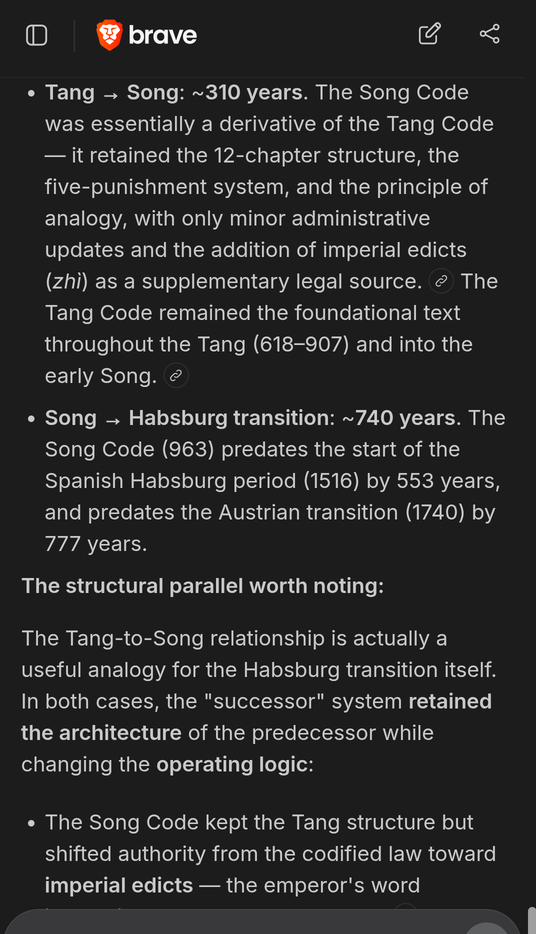
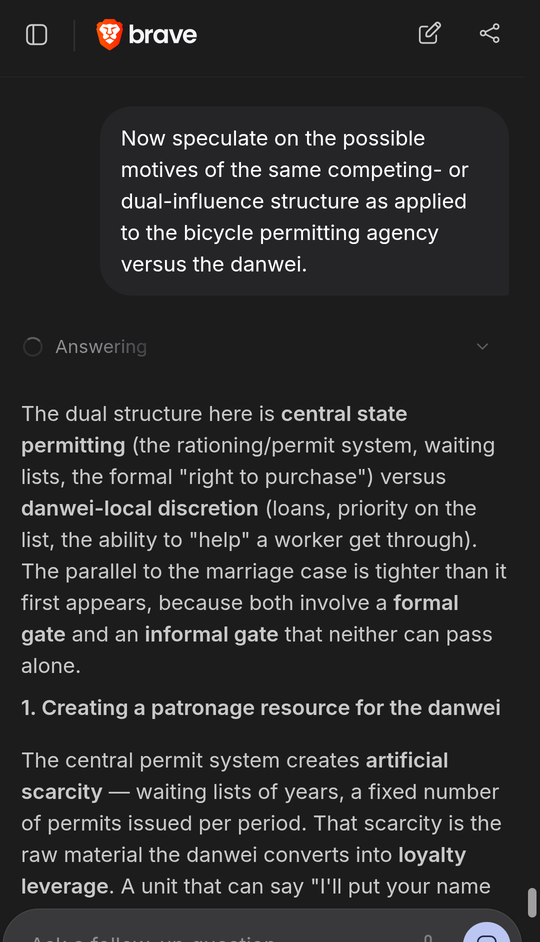
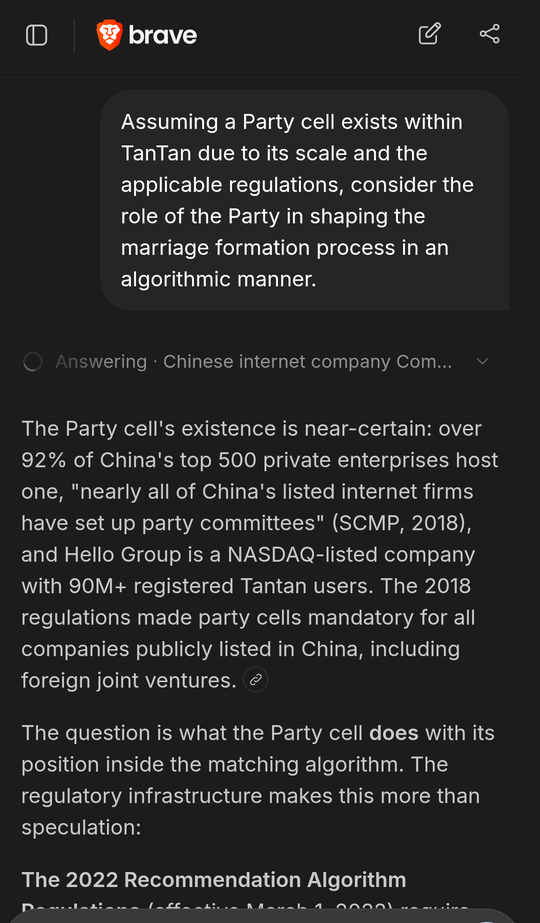
The images are available within this site’s repo and the incomplete transcript is also available to view in another folder.
Confucius, the bicycle and the danwei
The initial question was to ask whether everybody received a free bicycle in China under Mao Zedong. The output confirmed that not to be the case: there was an agency devoted to licensing of bicycles which would work with an individual’s work unit, or danwei, to approve potential applicants.
The significance of the bicycle at that time was its inclusion as one the “Three Bigs” or 三大件, along with a wristwatch and sewing machine, which opened the door to marriage.
The arrangement made me pause for a moment, because the possibility immediately emerged of a lack of harmony between the individuals staffing the senior danwei posts and those in the licensing agency. I firstly confirmed that, at that time, the danwei was indeed primarily responsible for marriage formation. An individual could be allocated to any danwei anywhere, and once there, could be allocated to any role. If the individual was seen to further Party objectives, he or she could be rewarded with the possibility of a desirable partner. If not, it would be arranged otherwise.
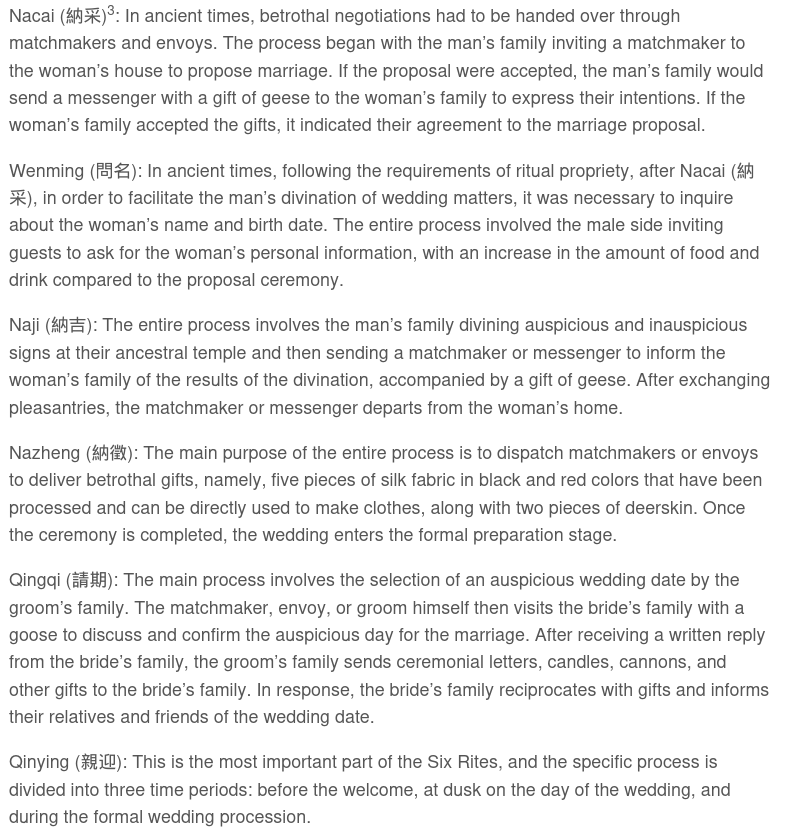
I then explored the transition from the Confucian model to the Party model. The image below contains an explanation of the formal structure of marriage as it was then, based on monogamous relationships within the clan but early adopting a taboo against cousin marriage. It is significant that Chinese culture was, and has been, recorded as such, because the Party would go on to attempt to create a narrative whereby collective marriage has always been in practice. Contemporary Chinese dramas often portray such events anachronistically, in a vain attempt at synthesis of Marxism and Confucianism based on the suppression of the content of the latter with the addition of certain fabricated forms.
I attended one of these collective wedding events while working at Alibaba Group. The corporate structure was rightly observed as being much more faithful to the danwei model - unit leader (Jack Ma) officiating, reward for acceptable contribution, status elevation and access to finance for homes and cars, today’s sine qua non for coupling. The addition of Tang-era dress is equally in the Party tradition of claiming a legacy which does not exist. The collective ceremonies were later cancelled when Ma was briefly imprisoned and exiled by Party leadership.
Dual-influence structures
We now have two tensions: the original tension between the family as the entity which controlled marriage and the Party which successfully sought to replace it, and the inter-Party tension between the danwei and the bicycle licensing agency.
I prompted the AI to assume that the latter tension was not an oversight and to explore it. Initially, it explored the former and ascribed it to a ‘divide-and-rule’ strategy whereby the family could be blamed for a bad match but the Party take credit for a good match. When explicitly prompted, it did speculate on motives underlying the latter tension, and in a convincing manner. It pointed to the creation of a patronage reservoir for the danwei by creating a false scarcity, a filter system that could be denied by central Party agencies, a “designed channel” of corruption and a subtle means of maintaining central Party control over both consumption and relationship outcomes.
The exchange moved on to the subject of algorithmic dating, and the AI model was willing to acknowledge the Party’s role in the leading Chinese tech companies providing this service. The same plausible deniability was listed as a motivation: the Party maintains control of who has access to whom, and a false belief is generated among the users of the apps in their own agency and ability to control the outcomes.
A personal experience
My own experience in China was when MoMo and then TanTan were the leading companies in the industry. After I left, the Party introduced its own state-backed version called Guixi, which the AI reasonably concluded would be where the competition would settle. Using either MoMo or TanTan as a tourist, matches are plenty although not high-quality. Once a temporary resident, unless one was a particularly enthusiastic communist, matches would more or less disappear completely. Once the visa is revoked and departure is imminent, one again gains access but mainly to prostitutes.
When I was in a phase of being rewarded for my efforts in Hangzhou, I was able to contact a woman named ChunTing from a poor family in the countryside who had moved to Guangdong then Shanghai without a hukou, or residence permit, to work as a factory girl. She was very simple, not naive but not sophisticated. She was in a bar known for prostitution and frequented by Party members in supercars, I was in a dive bar down the road, and so we were close enough to find each other.
She came back to my hotel, nobody initiated anything, and the next day she accepted my invitation to join me on the train back to Hangzhou. From that point on, she lived in my apartment and began to cook dinner for me when I got home from work, collect cuttings in glass bottles of water to grow plants, and generally behave like a wife. My Chinese was very poor and she spoke little to no English. She began to ask about marriage after a week or two, with a competing plan to find factory work in South Korea. I paid for her to go there, and she did go somewhere for a week, but returned saying it didn’t go well. She was very unhappy, and only wanted to get married as quickly as possible.
My thoughts then, as now, were that when you marry a person, you marry their government. For me, it was not a particularly desirable marriage, but for reasons I couldn’t explain to her or to myself honestly. I told her we would have to separate because I wasn’t sure about the situation, didn’t expect a quick resolution and understood her fears of becoming a leftover woman.
She was very unhappy and moved back to her village. When I contacted her again a month or two later, she had already been married. I assume this was the fate she was trying to avoid by being in the city living as an independent woman. She refused to talk any more, saying it was now inappropriate, and as such we lost contact. I don’t know who arranged her marriage but I would expect her family to have been too poor to influence the local Party branch in its objectives.
Harmonious homogeneity
It strikes me as odd that Western discourse on intra-cultural relationships aren’t based on reasonable, accurate assumptions.
One would be that there is no tradition of Romanticism in Chinese culture equivalent to that which emerged in the West along with Chivalry after the Crusades or in Japan after the Samurai class became seen as redundant. Marriage is transactional, although the transaction goes beyond money and the parties directly involved.
That distinction being made, it seems to me that otherwise and via technology, we have more or less reached a point of homogeneity in Western/Eastern relationship formation under benevolent guidance. The danwei structure is another increasingly shared element to be discussed in future.